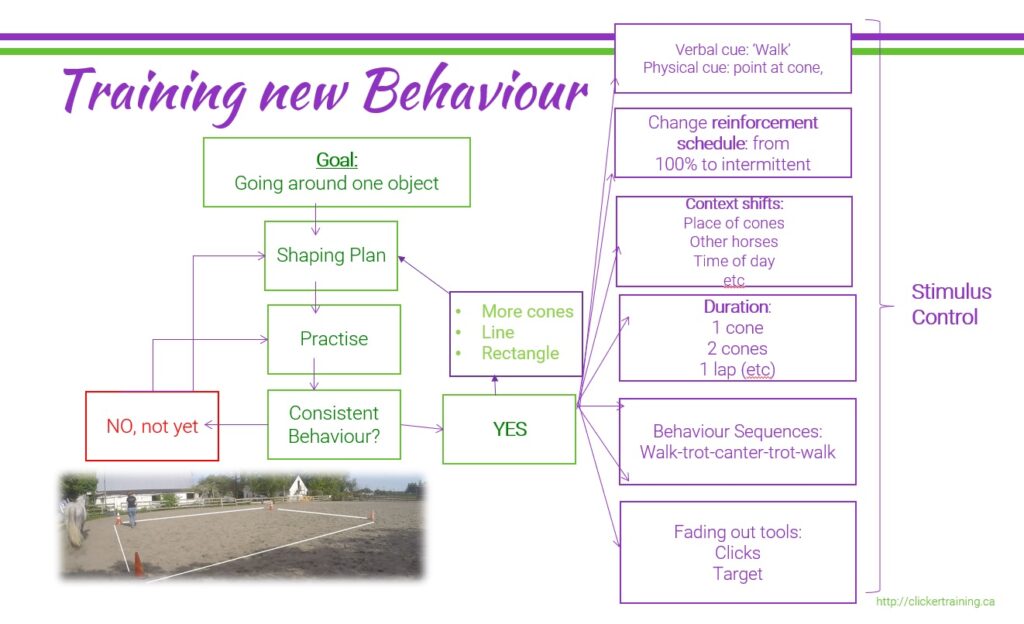
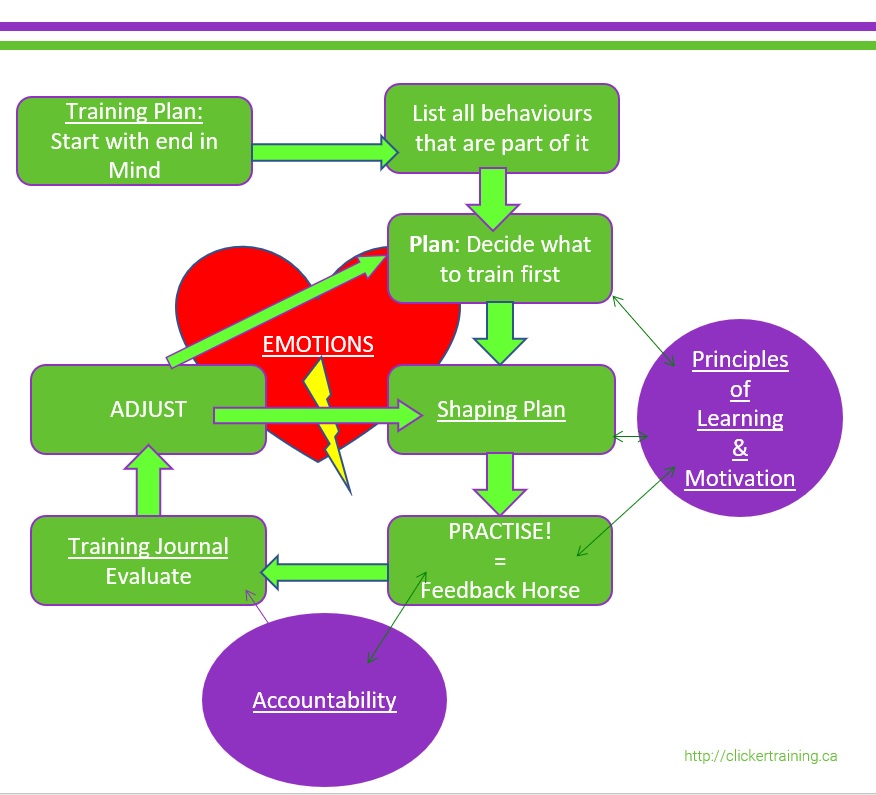
Here is my R+ Training system that will help you get Clarity in Clicker Training (see recording week 5 for more!). Part of the system is putting behaviour under Stimulus Control (SC).
Having a system means you always know What to do and When to do it. The Key Lesson ‘Principles of Learning & Motivation’ will help you understand ‘Why’ & ‘How’: in a away your horse understands what to do and with a reason so he will be willing to do it.
All words underlined respond with one of 6 Keys to Success for Trainers:
- Training Plan: your vision board for your horse and your equestrian life. Contains all your dream behaviours and dream outcomes
- Shaping Plan: a written manual for training a behaviour. This entails dividing your goal behaviour into small steps so that you end up with clear criteria for each training phase, including fading out training tools and putting the behaviour on cue.
- Principles of Learning & Motivation will help you design your training based on the natural behaviour (behaviour repertoire), wants and needs of your horse. You know when your horse is in a “Moving Away from”-energy (negative reinforcement/Punishment) and motivated by aversives, as well as when your horse responds with a “Moving Towards”-energy (positive reinforcement) and is motivated by appetites. You know the preferences of your goal species as well as the personal preferences of your individual learner.
- Accountability is what keeps you on track until you’ve achieved your goal(s). You can have internal accountability, or need external accountability or you thrive with a combination of both. A strong internal motivator can be that your value is to keep your horse healthy and meet his welfare needs. When you have internal accountability you’ll put the training of your horse into your agenda and simply do it. When you require external accountability, you need something or someone else to help you stay on track. Maybe not all the time and only in some circumstances (for instance training with a friend in Winter because you know you will let the weather dictate if you’re going to do some training or not). An example of external accountability is weekly lessons or training assignments to help you accomplish your goals, reporting your steps to your goal to your accountability partner or coach. Accountability together with motivation, is what keeps you going.
- Training Journal. A valuable part of training is to track your training (eg how many training sessions) and to evaluate your training (what have I accomplished, what are my strong points and what are some things I need to improve in order to get better results. Using a Training Journal can become an invaluable tool that will give you insights in training in ways you cannot get in any other way, except from a coach. You can track your training and results by filming your training sessions weekly and evaluating them. Once in a while compare your baseline video with your current results in order to get an idea of how much you’ve accomplished.
- Emotions in Training. I believe we are responsible for our own emotions in training and part for our horse’s emotions. A bit of frustration can lead to better learning, too much can lead to anger, aggression, learned helplessness and other undesired responses that inhibit learning. Therefore it’s up to us-trainers- to manage our horses emotions in training. When we see fear, we have to help our horse decrease his fear. When he enjoys something very much we can offer this more in training. Studying equine body language and the Pain Grimace Scale (Google it for images) will help us understand Equine Emotions in training better.
We also have to regulate our own emotional responses and learn how they influence training for better or worse. When we’re happy our cues are different than when we’re angry. It starts with awareness.
Stimulus Control means in theory:
- The behavior occurs immediately when the discriminative stimulus is given. In normal language: Your horse responds with the correct behaviour after your cue. Take into consideration that horses need time (1-4 seconds or longer) to process the cue. They need time to think!
- The behavior never occurs in the absence of the stimulus. I would like to add: ‘in your training set up’. Of course your horse will walk, trot and canter outside training. ‘Never’ is also (nearly) impossible to happen when we work with living beings like our beloved horses. We train (flighty) animals, not robots!
- The behavior never occurs in response to some other stimulus. This means that your horse won’t offer trot or walk, when you cued for canter. Most often multiple behaviours are happening at the same time: What, Where, How. ‘Trot’ is paired with ‘Around the cone’
- No other behavior occurs in response to this stimulus.[5] Like the previous point, no behaviour is offered in a vacuum.
Is Stimulus Control achievable in real life?
I don’t worry too much about having all behaviours under Stimulus Control as it is defined by science.
- We work with horses, not robots
- Our horses might not respond as quickly and immediately when trained with R+ (and expect our animals to make conscious decisions) than when we train with aversives and trigger their flight response and rely on their self preservation responses (because we use aversives and that’s what unpleasant stimuli will do). I do believe that horses in this sense are very different than for instance dogs, who can react super fast on R+ trained cues. Each species will respond according to their process time for human cues.
- Behaviour is not black and white. Many behaviours are a combination of multiple behaviours (trotting on a line, or bending, trotting around a cone, towards us or away from us etc.)
- We don’t train our horses in a laboratorium where the animals are only presented with one cue at the time. In real life we are working outside and when his herd member calls, your horse might feel the urgency to respond to that cue rather than your trot cue.
Redefining Stimulus Control
My personal definition of Stimulus Control in Horse Training is:
- Your horse responds to your cue in 0-4 seconds. You want your horse to trot within 4 seconds of your cue. You understand he needs time to process a cue.
- Once the behaviour is trained and on cue, your horse won’t offer the behaviour without your cue. For example: your horse will only trot around the cones after you cue him to do so. He won’t respond to the environmental cues (the cones).
- Your horse won’t offer the behaviour in response to another cue. When you cue ‘canter’, your horse won’t offer a trot.
- No other behaviours will be offered in response to your cue. When you cue ‘trot’ he won’t offer canter or walk.
A part of getting behaviour under Stimulus Control is to help your horse understand your cue and learn to recognize it. He also needs to generalize the behaviour: trot means trot when there are cones, when he’s at liberty, when he’s under saddle or lead on a lead rope. This is all explained in the R+ Training System.
Example of Shaping Plan (one behaviour) At Liberty Rectangle
Explained in the recording of week 5.